× Search

People Planet Profit Podcast – Episode 6

Welcome to the People Planet Profit Podcast.

I’m Hayley Jarick, CEO of the Supply Chain Sustainability School and today I’m joined by Dylan Frank.

Dylan spent his life growing up in the Blue Mountains spending his weekends either surfing or helping his dad out in the field. With a Degree in Commerce, Diploma in Surveying and Masters in Business Administration, Dylan is the Managing Director at Wumara Group.

Wumara Group is a proud 100% Indigenous owned and managed Land and Construction Surveying company. Their aim is to provide Indigenous Australians with employment and education opportunities. Their Indigenous heritage has enabled them to gain exclusive membership with Supply Nation and the New South Wales Indigenous Chamber of Commerce. And they have strong alliances with some of Australia’s biggest companies and Government Departments.

I am proud that the Wumara Group are the Supply Chain Sustainability School’s first Indigenous Fellow.  Welcome Dylan.

  • What is it like running an Indigenous business in Australia?
  • 3 things you wish procurement people knew about indigenous businesses?
  • 3 myths you want to see busted in 2022?

Publisher: Supply Chain Sustainability School Limited.
Presenter/s: Hayley Jarick, Dylan Frank.

Podcast audio: People Planet Profit Podcast – Episode 6 Talking Indigenous Business with Dylan Frank

People Planet Profit Podcast – Episode 5

Welcome to the People Planet Profit Podcast.

I’m Hayley Jarick, CEO of the Supply Chain Sustainability School and today I’m joined by Brendan O’Keeffe.

Brendan has over 20 years’ search, executive recruitment & consulting experience across numerous supply chains in the Australian market. He has become a trusted adviser for his service delivery, partnership engagement and industry collaborations.

Brendan has a passion for the Circular Economy and Supply Chain professional sector and is committed to supporting people and partnering with organisations.

Brendan is seeking to increase the awareness of sustainability and how we can all make a positive sustainable contribution to our futures. Part of his commitment includes completing Certificate of Sustainable Supply Chain Management with University of Cambridge, and he is a newly elected Director of the Supply Chain Sustainability School.

In this episode we talk to Brendan about:

  • Can you summarise the supply chain issues in relation to current delays and shortages?
  • What advice do you have for people thinking of moving into supply chain as a career?
  • What 3 trends do you think we’ll see in 2022?

Publisher: Supply Chain Sustainability School Limited.
Presenter/s: Hayley Jarick, Brendan O’Keeffe.

Podcast audio: People Planet Profit Podcast – Episode 5 Talking Supply Chains with Brendan O’Keeffe

People Planet Profit Podcast – Episode 4

Welcome to the People Planet Profit Podcast.

I’m Hayley Jarick, CEO of the Supply Chain Sustainability School and today I’m joined by Daniel Wurm.

Daniel is a qualified trainer from the construction industry with a passion for sustainable education. In 2009 he created the award-winning GreenPainters program for the painting industry, educating over 600 painters in 3 countries. He is a member of the Construction and Property Services Industry Technical Advisory Group, and a director of the National Institute of Painting and Decorating. He has created courses for the NSW Green Skills program and co-written sustainability resources for Holmesglen TAFE Innovation and Learning. In 2015 he created the Green Tradies program and won Trainer of the Year at the NSW Training Awards in Sydney.

He is a qualified tradie, holds a Diploma in Vocational Education and Training, a Diploma in Business; and since 2017 has managed Green Building Institute’s Energy Smart Builders Program for the Cross-Industry Skills Training Program. In addition to writing technical courses for builders and tradies, he teaches business subjects and courses to tradies who are keen to become more sustainable.

Green Building Institute is a Fellow of the Supply Chain Sustainability School.

In this episode I talk to Daniel about:

  • what is it like running a sustainable small business
  • top five new tricks that the ‘old dogs’ in the building industry should learn
  • three sustainability myths that need to be busted in 2022.

Publisher: Supply Chain Sustainability School Limited
Presenter/s: Hayley Jarick, Daniel Wurm.


Podcast audio: People Planet Profit Podcast – Episode 4 Sustainability tradie talk with Daniel Wurm

People Planet Profit Podcast – Episode 3

Welcome to the People Planet Profit Podcast.

I’m Hayley Jarick, CEO of the Supply Chain Sustainability School and today I’m joined by Michael Tomlinson.

Michael is the Managing Director of PointsBuild.

PointBuild is a Knowledge Fellow of the Supply Chain Sustainability School and specialises in online CPD courses for Australian Architects, Designers, Engineers, Builders, Trades, Certifiers and Surveyors.

Michael founded Pointsbuild in 2007, and is responsible for Pointsbuild’s leadership, company strategy, the execution of plans, and key partnerships.
His strategy is simple: he wants PointsBuild to be the best at what they do.

Michael has worked in various technology companies in Australia and internationally for the 15 years prior to PointsBuild.

He has experience in:

  • Business management and revenue growth
  • Team Leadership and Management
  • Account and Relationship Management
  • Established businesses & start-ups
  • Public Sector, Education, Construction and Information Technology industries.

We are going to talk today to Michael about:

  • Adult education in 2022
  • What non-sustainability professionals want to know about sustainability
  • Operating a small business from regional NSW.

Publisher: Supply Chain Sustainability School Limited
Presenter/s: Hayley Jarick, Michael Tomlinson.


Podcast audio: People Planet Profit Podcast – Episode 3 Sustainability talk with Michael Tomlinson

People Planet Profit Podcast – Episode 2

Welcome to the People Planet Profit Podcast.

I’m Hayley Jarick, CEO of the Supply Chain Sustainability School and today I’m joined with Robin Mellon.

Robin has combined his love of the environment, passion for sustainability, experience with supply chains, and qualifications in real estate and finance to become one of Australia’s experts on sustainable supply chains.

The former Chief Operating Officer of the Green Building Council of Australia, and founding CEO of Australia’s Supply Chain Sustainability School, Robin is now CEO of Better Sydney, Project Manager for the Property Council’s Modern Slavery Working Group and Supplier Platform, and NSW Program Adviser for Better Building Finance.

Robin was a member of the Australian Government’s first Modern Slavery Advisory Committee, is a Judging Chair for the NSW Sustainability Awards and Banksia Awards, one of the International WELL Building Institute’s Global Advisory, and a member of Waverley Council’s Environmental Sustainability Advisory Committee.

Publisher: Supply Chain Sustainability School Limited
Presenter/s: Hayley Jarick, Robin Mellon

Podcast transcript: People Planet Profit Podcast – Episode 2 Talking with Robin Mellon

What you know AND what you don’t know

– Feature article contributed by Robin Mellon, CEO Better Sydney –

Thousands of organisations across Australia are now producing their first Modern Slavery Statement to publish on their website and submit to the Australian Government. Although some international organisations have been reporting under the UK Modern Slavery Act for several years, for the majority of reporting entities this is when ‘the rubber hits the road” and they bring together what has been done, what is underway, and what is yet to come, into a Statement that will be viewed by clients, employees and suppliers. For these organisations, and those within their extended supply chains, I have three suggestions.
1) Now IS the time to be talking about modern slavery:

I’ve been concerned to hear recently, from several large organisations with far-reaching supply chains, that “now isn’t the time to talk about modern slavery as we’re trying to deal with COVID-19”. I understand the focus needed to cope with the pandemic and its impacts, but we are already seeing suppliers abandoned, discounts requested, and payments delayed. It is likely that the parts of our supply chains least able to cope with the social, physical and economic distress of COVID-19 will be those bearing the brunt of supply chain disruption. Recent articles highlight how our supply chains start to experience these difficulties: “Suppliers under pressure as Australian retailers ask for discounts” and “Call centre workers in the Phillipines sleeping in offices”. The Australian Government has outlined some of the key actions organisations can take to reduce the risk of vulnerable workers in their operations and supply chains becoming exposed to modern slavery as a result of COVID-19. So now IS the time to be talking about human rights and modern slavery within our supply chains, as a fundamental part of responsible business, better supplier engagement and truly sustainable procurement. Saying “we don’t have time to prioritise human rights” is just not acceptable; it indicates a broken business model.

2) Use this ‘extension’ to prioritise, engage and educate:

Although the Modern Slavery Act 2018 requires organisations to submit modern slavery statements within 6 months after the end of their reporting periods, this deadline has been extended by an additional three months for all entities whose reporting periods end on or before 30 June 2020 in order to support reporting entities impacted by the COVID-19 pandemic to meet their obligations. The extension recognises that the pandemic is significantly impacting many reporting organisations, and offers additional time to assess changing modern slavery risks linked to COVID-19 and prepare and submit their modern slavery statements. So how should reporting entities be using this time? Firstly, by prioritising their actions; perhaps tier by tier, or country by country, according to the risk of harm to people. Secondly by engaging more with their extended supply chains and creating more of a ‘two-way street’; seeing what they can do for their suppliers, not just setting out their procurement requirements. And thirdly by increasing education and raising awareness through their operations and supply chains; using free learning resources such as those provided by the School to build capacity across every tier of their supply chains to assess and address the risks of modern slavery.

3) Be aware that modern slavery is easier to assess and address when considering areas you know you know, trickier when looking at what you know you don’t know, and downright difficult when thinking about areas you don’t know you don’t know:

I’ll put this another way; working with Tier 1 suppliers (the businesses you know you know) provides a level of data you can be reasonably sure about. Assessing human rights issues beyond Tiers 2 and 3 of your supply chain or your suppliers’ suppliers (the businesses you know you don’t know because your suppliers talk about ‘commercial in confidence’ arrangements when you ask, or perhaps don’t know themselves) gets tricky. It’s the modern slavery risks in the areas of your supply chain you don’t know you don’t know – instances when things have been sub-contracted without your knowledge to achieve a deadline, or procured from a new vendor without following protocols to meet a project milestone – that can be hardest to address. This is where you need to adopt a ‘cascade’ approach within your operations and supply chains, pushing awareness of human rights, education about modern slavery, responsiveness to the right procurement procedures, and knowledge of grievance mechanisms through every part of what you do. And don’t be afraid to work with third party organisations – not just consultants but civil society and NGOs – to get a different perspective on your operations and supply chains; people much more likely to tell you objectively and constructively what you don’t know you don’t know.

Robin Mellon is one of Australia’s experts on property, construction, supply chains and sustainability in the built environment. As the CEO of Better Sydney, he is Project Manager for the Property Council of Australia’s Supplier Platform and Modern Slavery Working Group, the NSW Program Adviser for Better Building Finance, was on the Australian Government’s first Modern Slavery Expert Advisory Group, and was the inaugural CEO of the Supply Chain Sustainability School.

The Australian Supply Chain Sustainability School (the School) is celebrating its five-year anniversary and this milestone is an opportunity to reflect on how far not only the School has come, but also our industry.

School CEO, Hayley Jarick says that “organisations are leading the charge to a more socially, environmentally and economically sustainable future in the ‘decade of change’. And they know that the only way to make a difference is to act collectively and enable their partners to act.”

Sustainability knowledge has moved from being niche to an operational imperative and the School has come into its own and is well placed to meet growing industry demand. “There is a lot of opinion readily available and expert information is becoming harder and harder to decipher through the noise. The School cuts out the noise and provides our members a free learning platform about the topics that matter in our industry,” says Jarick.

Since the School launched in 2015, it has grown steadily from just 8 founding Partners, 200 Members and 10 learning modules. Now, the School boasts 30 Partners, 1,684 Member companies, 2,698 registered users and there have been over 4,300 learning resource views. In addition to these key growth areas, the School has succeeded in:

  1. Developing an online self-assessment tool for businesses to rate their knowledge and develop a custom sustainability learning program. 
  2. Making sustainability training accessible to regional Australia (anywhere with internet). 
  3. Created informative, relevant resources by industry for industry.  
  4. Meeting the UN’s Sustainable Development Goal #17: Partnerships grew from…
  5. Launching a new website, that meets digital best practice from its user experience to learning management system capabilities. 

Jarick is proud of the evolution of the School so far and says that it’s been a privilege to be connected to the School since it launched five years ago, wearing a few different hats along the way. I am fortunate to be the latest in a line of leaders that have lifted the School up over this time.  I was excited to launch the new website last December with a stack of new functionality for Members and Partners but my proudest moment has been speaking with new Members after Partner supplier workshops and seeing so many new faces join the cohort of companies bettering the industry. 

She continues, saying that becoming a Member gives you the resources you need to better your company but organisations that are looking to lead the industry should become Partners. We have a range of Partner categories to suit all types of organisations and their needs.  Our Partners enjoy developing resources, events, workshops, personalised School landing pages, managing their priority supplier’s learning, managing project learning, attending exclusive events, as well as showcasing their successes through the School’s channels.  

Laing O’Rourke can attest to the benefits of Partnering with the School, saying that “the School’s work to help upskill and support the supply chain on sustainability has made a real positive difference to our business and the industry. The resources and collaborative learning environment the School has set-up has and will continue to play an important role to promote and influence the right skills, services and products to match the sustainability needs on our projects. 

The School has many long-standing supporters who have been pivotal to the School’s continued success such as Founding Partner, Downer Group. Ricky Bridge, Downer’s Group General Manager – Sustainability, Reporting and Data Analytics, says that this “milestone marks five remarkable years of being the ‘go to’ innovative online platform for our contractors and suppliers to engage in education and knowledge on sustainability related issues and better equip the supply chain for future success.” 

Robin Mellon, CEO of Better Sydney, reflected that “it’s been amazing to see the School’s trajectory over the past five years – three of which I spent as the School’s inaugural Chief Executive Officer – and how the team is working with more partners, more projects, more topics, more governments and not-for-profits, and more learning resources than ever before. 

So, what is on the horizon for the sustainability industry and how will the School continue to adapt to the needs of the market? Jarick says that “a lot of people in the sustainability field come from an environmental perspective with a tremendous ability to influence people with a like-minded desire to take care of the planet. We are seeing a trend for broader social and economic sustainability to be incorporated into this mix which had brought with it challenges and benefits. 

For instance, people are taking on board the intent of the Modern Slavery Act and changing their management approach of those who don’t initially comply with sustainability goals. Instead of blacklisting and avoiding non-complying companies, now the trend is to use your position of influence to work with others towards compliance. This is transformational for the industry and means that many in the industry will need to learn or refresh their emotional intelligence and conflict management skills. 

Jarick states that “the School is constantly evolving to changes and future needs. We are evolving the types of resources we have, to cater for changes in how people want to learn. We are adding new resources every month and reviewing old resources to ensure our catalogue only contains the best resources. We are also looking to expand the School in new markets, so watch this space.   

For more information, please contact:  

Hayley Jarick, Chief Executive Officer
Supply Chain Sustainability School  
E: [email protected] 
2019 was a massive year in terms of progress for Australia’s Supply Chain Sustainability School (the School) and 2020 is shaping up to be even bigger with the announcement of four new partnerships. The Cleaning Accountability Framework, CIMIC Group, The GPT Group and Talent Nation have all committed to collaborating with the School.  

“It’s an amazing compliment to all our Partners when new organisations come onboard,” says the School’s Chief Executive Officer, Hayley Jarick. “The cohort of The Cleaning Accountability Framework, CIMIC Group, The GPT Group and Talent Nation may sound like an odd mix, but the School is winning on many fronts at the moment so it’s not surprising to see newcomers from different arenas.” 

The Cleaning Accountability Framework (CAF) is an independent, multi-stakeholder organisation with the objective of improving working conditions for cleaners and promoting decent work across the property services sector in Australia. CAF aims to empower organisations to identify, remediate, and monitor compliance issues through their supply chains which are identified through CAF Building Certification. 

CAF takes an educative approach to compliance and has been developing resources and training modules to help building managers, cleaning contractors and cleaners to monitor ongoing compliance at their sites. There is obvious synergy with the School and CAF CEO, Poonam Datar, says that “working together, we hope to develop even more educative resources, particularly around labour rights compliance, for all stakeholders and interested parties to learn more about how they can promote and uphold responsible business conduct.” For more information on CAF visit: https://www.cleaningaccountability.org.au/ 

CIMIC Group is a world-leading infrastructure, mining, services and public-private partnerships group. CIMIC Group is committed to operating sustainably by leveraging its global experience and expertise and by integrating environmental, social and governance (ESG) factors into their decision-making. At the core of their commitment to sustainability is being a trusted partner to clients, partners, suppliers, communities and wider stakeholders. Their sustainability approach is holistic and anchored in our Mission and Principles. Our Board, its committees and our governance framework, including our Code of Conduct and policies support, drive and track our sustainability approach and performance.  For more information on CIMIC Group visit: www.cimic.com.au/ 

The GPT Group is one of Australia’s largest diversified property groups and a top 50 ASX listed company. GPT owns and manages a $24.8 billion portfolio of retail, office and logistics property assets across Australia. 

GPT aspires to be internationally recognised for its leadership in sustainability. Sustainability practices underpin our day to day operations and are integrated into our organisational culture, stakeholder engagement, governance and business processes. GPT has long been committed to delivering sustainable outcomes for our business and stakeholders, and is a demonstrated leader in sustainability both locally and internationally. 

GPT says, “Our partnership with the Supply Chain Sustainability School will help facilitate sharing of critical knowledge and experience with our peers, suppliers and industry partners as we collectively work to address Modern Slavery. Their resources and case studies will help shape our Modern Slavery education and awareness programs, while at the same time enable the continual improvement of our business practices and those of the businesses we work with, through their competence in social, environmental and economic sustainability.” For more information on the GPT Group visit: www.gpt.com.au  

Talent Nation is a Certified B Corporation that specialises in roles to help drive sustainability and environmental agendas within corporate and Not-for-profit clients. Talent Nation believes real impact in sustainability initiatives can’t be made without the right people in place, and their mission is to unearth these people and connect them with the roles and businesses in which they will thrive. Talent Nation has extensive networks to tap into to fill the increasingly in-demand Sustainability roles, and the ability to identify candidates who have not only the skillset and experience, but mirror the values, passion and vision of their future employer.   

By becoming a Partner of the School, Talent Nation want to ensure that they understand the demands their clients are facing. Additionally, Managing Director, Richard Evans, says that we “recognises the strong role that the School has played in educating the market here in Australia. We are excited about joining the school as a Partner as we believe that it will continue to play an increasingly important role in transforming supply chains across Australia, and globally.” For more information on Talent Nation visit: https://talentnation.com.au/ 

Hayley Jarick says “It’s an exciting time to join the cohort of organisations partnering to achieve sustainable development through mass education. We’ve just created new Partnership categories to cater for the growing interest in businesses looking to collaborate and showcase their environmental, social and economic sustainability leadership. It’s not too late to join us and ride this exciting wave into the 2020’s!” 

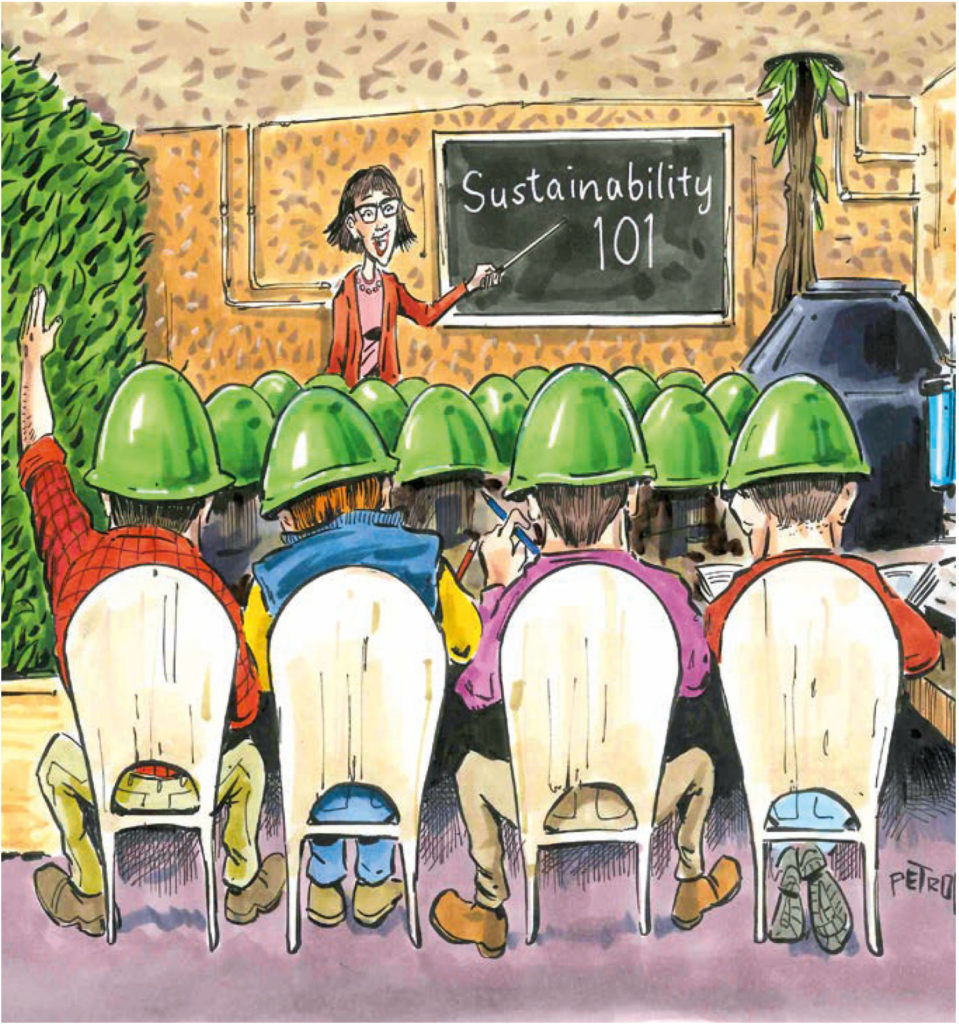
Sustainability has been a buzzword floating around the industry for some time now. Some people get it. Some people don’t. Much of the ‘don’t’ camp has likely been put off by the ‘tree hugging, extreme group’ stigma associated with the ‘S’ word. But an e-learning platform, started in 2015, is working hard to ensure that stigma is put to bed.

The Supply Chain Sustainability School is essentially a collaboration of partnerships between some of Australia’s biggest players in the construction industry to achieve one common goal: sustainability knowledge and competency along the construction and infrastructure supply chains. It isn’t just for the big guys either. With an emphasis on supporting small-to-medium enterprises, the school achieves the aforementioned goal by providing free e-learning, information and face-to-face training for construction and infrastructure suppliers, contractors and service providers.

Companies, teams or individuals that sign up can access a wealth of free resources and tools to meet increasing sustainability demands and performance benchmarks, and to help build clever, collaborative and competitive construction and infrastructure sectors.

Full Circle

Hayley Jarick took over as CEO in May, and after being an Advisory Board member during the school’s inception, she’s excited to come back and apply knowledge garnered from her time with the Infrastructure Sustainability Council of Australia (ISCA) where she initiated the ISupply program and BlueScope Steel where she championed the marketing of steel’s sustainability credentials. She’s as passionate as ever about the movement too.

“Once you get into sustainability it’s really hard to get out of it because it’s one of the most fulfilling jobs you’ll ever have,” Hayley explains.

“It’s so rewarding across so many aspects. There aren’t too many other jobs that would allow me to sit in front of something tangible with my grandchildren one day and explain how our actions made a massive difference to their lives. How could you say no to a role like that?” Hayley exclaims.

Over the past year or two Hayley has noticed a strong growth curve in the social sustainability aspect of things and believes the concepts of industry reporting and ethical governance of corporations is coming into view more strongly than say 5-10 years ago.

“I think social sustainability is becoming more mainstream. When I first got into sustainability, it was dominated by environmental sustainability. But now it’s definitely evolved into that initial concept of what sustainability is, which is making sure our grandkids have the same or more options available than we have today.” There’s a lot of information on sustainability out there in the industry and online but as Hayley explains, the school, in response to calls from the industry, aims to be that single point of truth.

“All the resources we develop are essential to everybody. If we can get as many people talking the same language about the basics, then we can enable innovation to happen in a more sustainable way.”

Do a little bit now

It’s easy to see why the big players would benefit from such a service, given the procurement process now requires a more holistic approach that looks far beyond cost alone, but for the smaller builders, it can be hard to see the benefits of such a school. Hayley explains why you need to be aware of sustainability in the construction industry.

“The key message I have for everyone in small to medium businesses is this: if you want your business to be around in five years time, then you have to start evolving today for what that world is going to look like. if you don’t want to keep playing that race-to-the-bottom game and you want to put your business out there as something more valuable than the baseline, then you’re going to have to diversify in some way, shape or form in this realm.

“That doesn’t mean you have to target every element of sustainability in one hit, but I’d encourage you to find your niche. Find what works for you and understand how to communicate that when you’re selling your business as a subcontractor, so that people are fully aware of what your sustainable value proposition is.”

Hayley has taken inspiration from the Teaspoon for Change Movement whereby she encourages business to slowly gather their momentum and value by doing ‘a little bit now’.

“If you want to figure out how to position your business as something that the big players consider is worthy of having a relationship with on a consistent basis in the future, then there’s a stack of free resources available that can help to bring you up to speed. Sign up and do 10 minutes. Do a half hour e-learning course or watch a five-minute video. Just do something to help you compete.”

If you’re interested in joining the school, you can take advantage of its benefits in a number of ways. You can sign up for a free membership and go through the entire resource library and find something of interest to you or you can do a self assessment designed to help you assess your company’s current sustainability strengths and to identify the areas in which you can develop your competence. From there, the sky really is the limit.

Visit Building Connection Magazine.